EPM29011 covers the historic Ridgelands Goldfield with a ‘walk-up’ target
Historical 1980’s exploration results at Ridgeland show;
gold in soil anomaly >0.05g/t (assays up to 6g/t gold)
rock samples up to 6g/t gold
intersections up to 10m @ 15g/t gold from limited shallow RC drilling (average down hole depth 16m)
gold occurs in fractures, veinlets and veins in a magnetic intrusive
‘Pencil porphyry’ and intrusion related copper-gold targets
No detailed geophysics or ‘depth’ exploration at
Multiple targets in addition to Ridgelands
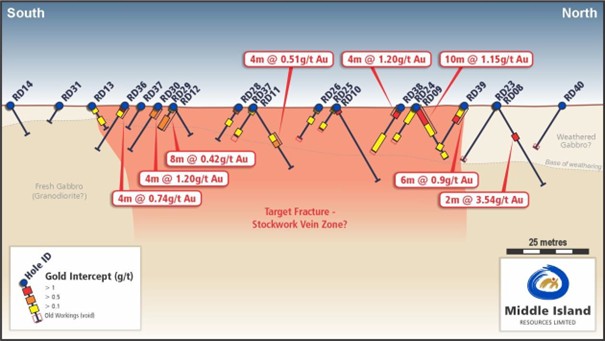
Limited 1980’s shallow RC drilling conducted at the primary walk-up target at the Ridgelands Goldfield recorded broad zones of low grade (≥0.1g/t) gold mineralisation (Figure 1) with:
six holes terminating in historical mining voids;
four holes ending in low tenor gold mineralisation; and
best intercepts ( >1g/t cutoff grade) of:
2m @ 15 g/t gold; hole RD7 from 0m depth down hole
2m @ 54 g/t gold; hole RD8 from 10 depth down hole
6m @ 78 g/t gold; hole RD9 from 0m depth down hole
2m @ 03 g/t gold; hole RD10 from 0m depth down hole
2m @ 68 g/t gold; hole RD17 from 6m depth down hole
2m @ 24 g/t gold; hole RD36 from 0m depth down hole
2m @ 2.34 g/t gold;hole RD39, from 4m depth down hole
The drilling was a shallow partial test (Figure 1) of a coherent coincident gold in soils anomaly and magnetic anomaly (Figures 3-5).
The gold mineralised zone is coincident with a spot magnetic high (one of several) on the margins of the Ridgelands Granodiorite that’s considered as a probable source of mineralisation through the area. Relationships suggest potential for pipe-like intrusive or ‘pencil porphyry’ deposits; a type of deposit characterised by elongated, often narrow, and often high-grade mineralised core. Apart from the historical test of the surficial skin of the gold zone, no apparent detailed geophysics or deep drilling has been conducted at Ridgelands or on nearby similar magnetic targets.
Figure 1. Schematic X-section showing historical (1980s) drill results across the Ridgelands Prospect gold mineralised zone (see figure 5 illustrating the relationship with a ~500-700m diameter coincident gold-in-soils and magnetic anomaly).
Ridgelands has potential for definition of a gold resource at surface and gold ± copper at depth. Any discovery would have the advantage of proximity to power, road, rail and port infrastructure.
Other identified targets include lode gold, and copper-gold skarn style mineralisation at the contact of the Ridgelands Granodiorite. Testing of identified skarns has been patchy and primarily undertaken by Esso Australia in the 1970’s.
The next stages of work will include field check sampling and mapping and landowner access discussions. Anticipated exploration forward programmes include detailed geophysics (eg. IP) and drilling (both shallow and deep) subject to the results of field checks and geophysics.
Regional Setting – Ridgelands
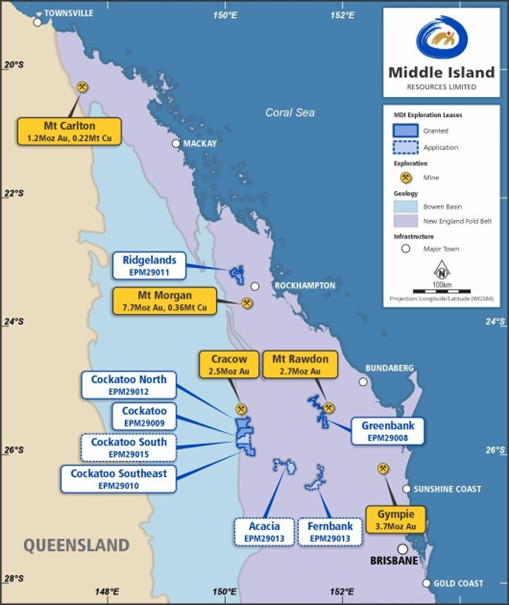
EPM29011 covers the historical Ridgeland goldfield located about 35 km WNW of Rockhampton, Central Queensland. Ridgelands is one of several historic Goldfields located within 50km north of the giant Mount Morgan gold-copper-silver deposit.
The project area covers rocks of the Yarrol Province Forearc Basin of the New England Orogen – part of a then convergent continental plate margin above a west-dipping subduction zone. The basin comprises Late Devonian to Permian strata that accumulated between a volcanic arc (west) and an accretionary wedge (east). The sequence is dominated by volcaniclastic sediments (late Devonian) and limestones (early Carboniferous). Gold (±copper) mineralisation at the Ridgeland’s and nearby Morinish Goldfield is spatially associated with the Permian-Early Triassic Ridgeland’s Granodiorite intrusive complex that intrudes these rocks.
Historical Background
Gold was discovered and mined at many places within the district from 1866 with production in the area peaking in 1868 – 1869. No significant gold exploration is known to have been completed at Ridgelands since mining in the late 1800’s except for work conducted by Saracen Minerals NL JV (“Saracen”) in 1986 -1990. Saracen completed a comprehensive archival review of the area and concluded “to all intents and purposes, these goldfields have been forgotten by the mining industry and have not been tested for gold”. In addition to gold, historical references note the presence of copper sulphide in some workings. Copper sulphides are also noted at several locations associate with magnetite skarns at the contact to of the Ridgelands Granodiorite, including associated with the magnetic highs north of Ridgelands by Esso Australia Ltd in 1974.
The Ridgelands gold workings are an extensive area of shallow shafts (maximum depth 24.4m within the weathered zone) within an area of distinctive reddish soil. Mapping indicated there are several larger (0.5-3.0m wide) parallel reefs with possible flat dips that were selectively mined. Early assays reported from Kirker reef were as high as 214 g/t gold (Burrows, 2004).
Previous Exploration
The most recent and only material exploration work on the Ridgeland’s Goldfield was undertaken in 1987 to 1988 by Saracen.
The work at Ridgeland included:
soil sampling that defined an extensive area approximately 500m x 220m of >100ppb (0.1g/t) gold in soils with several assays > 1g/t and up to 66g/t (within a broader >50ppb Au anomaly). The extent of the soil anomaly is open to the N and NW.
mapping and surface rockchip/float sampling returning values up to 6 g/t gold (see ASX Release 13 June 2025).
very shallow RC drilling (two perpendicular traverses of angled holes 6 to 35m deep) reported as having “indicated the existence of a shallow low tonnage and low grade gold” deposit. Best drill intersection 10m @ 15g/t gold (see ASX Release 13 June 2025) and recording several 2m sample gold assays of >1g/t up to 3g/t gold with several of the holes having intersected or ended in shallow mine workings (voids).
No modern geophysical surveys have been conducted to date or drilling below ~30m vertical depth has been conducted at Ridgelands.
Other historical copper-gold exploration work within the project area outside of the Ridgelands Goldfield is limited to regional rock and stream sediment sampling and some detailed work, primarily at two prospects, near the Morinish Goldfield. The more detailed work included prospect scale localised ground magnetics by Geopeko 1982 (at Ellrott Skarn), IP surveys by Esso Minerals (1974) (none immediately across the Ridgelands magnetic targets) and grid soil surveys by Carpentaria Exploration (1988-90) (at Marble Ridge) with sparse reconnaissance follow-up drill holes by these explorers (refer to ASX Release 13 June 2025).
Exploration Targets
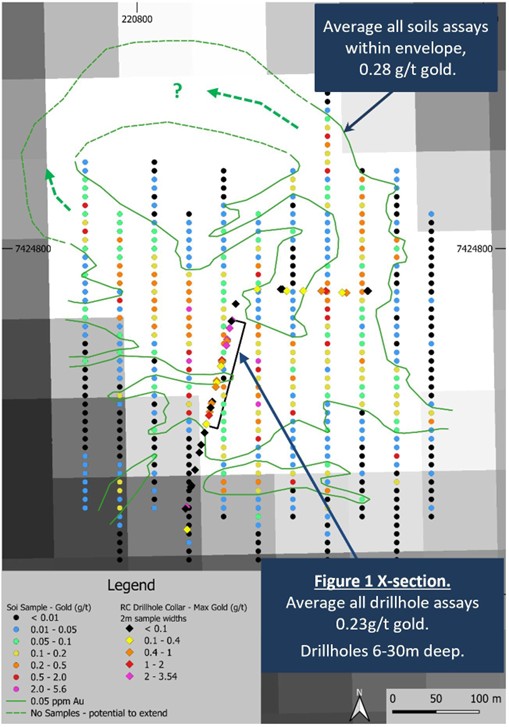
At Ridgeland’s the average grade of the soil samples within the >50ppb gold contour is 0.28ppm (g/t) gold. The shallow drilling (<25m vertical depth predominantly within the surficial weathered zone) tested a portion of the anomaly at depth; drill results included an area approximately 110m wide corresponding to the gold in soils anomaly where all downhole gold assays averaged 227 ppb (0.23g/t) gold comparable to the gold in soils.
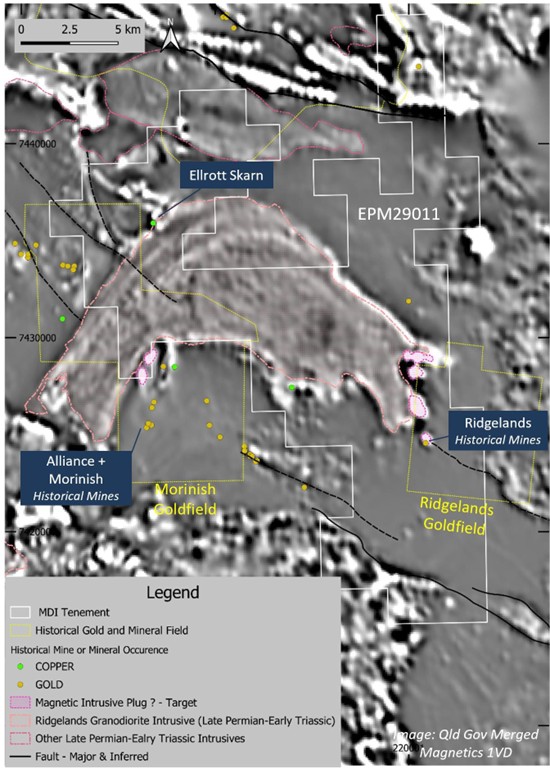
The soils and drilling gold anomaly and area of historical working are coincident with a spot magnetic high (approx. 700m in diameter) evident in regional magnetics (Figure 3 & 4) mapped as a small intrusive plug (diorite to coarse gabbro) that is part of the Late Permian-Early Triassic Ridgeland’s Granodiorite suite. Within the mineralised zones, drill logs note common chlorite alteration with the gold occurring with zones of thin fractures and veinlets or veins within the intrusive rocks.
The primary focus is the ‘walk-up’ Ridgelands target. Other opportunities have been identified for assessment including: several interpreted intrusive plugs similar to Ridgelands; potential for copper skarns on the contact of the Ridgelands granodiorite (the small Ellrott Skarn copper mine is hosted in limestone on the western contact of the Ridgelands granodiorite); and, extensions of the Morinish Goldfield gold lodes.
Figure 2. MDI’s Qld New England Fold Belt exploration project locations. The Ridgelands Project is located 35km WNW of Rockhampton and ~48km N of the Mt Morgan mine.
Figure 3. Regional magnetic image illustrating the relationship of the Ridgelands Goldfield, other historical mining workings, and the mapped and interpreted intrusive complex. Note white on the greyscale image corresponds to magnetic highs.
Figure 4. Ridgelands Goldfield area magnetic image illustrating the coincident gold in soil anomaly with a ‘spot’ magnetic high (white) that correspond to a mapped intrusive plug. Other target highs for testing on the margins of the exposed intrusive complex are evident immediately to the north and other locations (see Figure 2).
Figure 5. Plan of Ridgelands Prospect historical (1980s) soil sampling and RC drilling results, overlain on magnetics. The soil anomaly has only been tested with two perpendicular lines of shallow RC drillholes; six of the holes were terminated in voids (probable historical mine workings). No records of deeper drill testing or electrical geophysics across the target have been located.