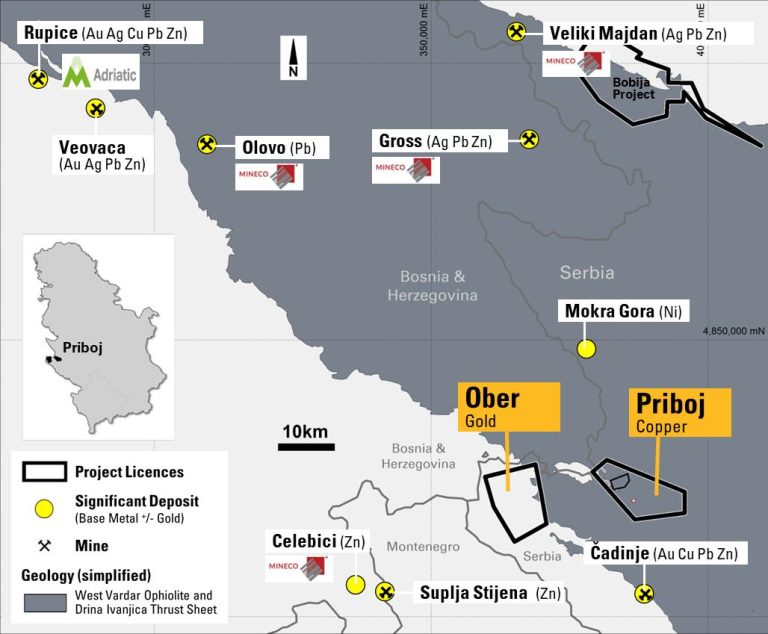
The Priboj Project area is located in southwestern Serbia, approximately 12 km north of the town of Prijepolje and 160 km south-southwest of Belgrade.
The project comprises three granted exploration licences (Jermovac, Priboj and Ober) covering an area of 195km2 (refer Figure 1).
The Priboj Project area lies within a highly mineralized northwest-southeast trending corridor that hosts significant mineral deposits, including Adriatic Metals’ Vares Project (Rupice and Veovaca silver lead-zinc deposits) located 100km northwest of the project area, and the Cadinje copper-gold skarn deposit immediately to the southeast. Numerous other polymetallic deposits and operating mines are also located across the region.
No prior exploration has been recorded across the entire Priboj Project area prior to the commencement of exploration by Konstantin.
Figure 1 – Priboj project location and access map.
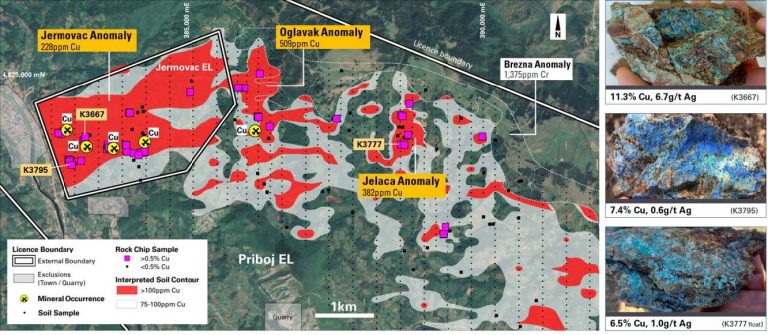
Within the eastern exploration licences (Priboj and Jermovac licences), the Company is targeting large scale copper systems, with some of Konstantin’s surface sampling program from the Priboj Copper target returning:
Sample K3667: 11.3% Cu and 6.7g/t Ag (outcrop)
Sample K3795: 7.4% Cu and 0.6g/t Ag (outcrop)
Sample K3777: 6.5% Cu and 1.0g/t Ag (float)
Copper mineralisation in the Priboj area is interpreted to be of VHMS (volcanic-hosted massive sulphide) deposit style.
Figure 2: Priboj Copper target and surface sample examples.
The immediate exploration program at the Priboj Copper Target will focus on further infill soil sampling together with an extensive trenching and rock chip sampling program to identify and define drilling targets.
In the Priboj licence, infill soil sampling programs will target the Oglavak and Jelaca Prospects where significant copper-in-soil anomalies have already been defined over approximately 800m x 1,200m and 500m x 800m areas respectively.
Multiple phases of soil sampling will also be implemented within the adjacent Jermovac licence where significant copper-in-soil anomalism has already been recorded from the initial wide-spaced (400m-spaced) sample lines.
Extensive rock chip sampling and/or trenching programs are planned to follow up areas of greatest copper-in-soil anomalism. The Company will also assess the potential for the use of electrical geophysical surveys (including induced polarisation surveys) to test for copper sulphide mineralisation at depth prior to initial drilling programs.
Within the Ober licence (western licence area), the Company is targeting sediment-hosted gold mineralisation associated with intrusive/volcanic rocks. Konstantin’s surface sampling program from the Ober Gold target has returned:
Sample K324: 1.1g/t Au and 1.1g/t Ag (float)
Sample K1353: 1.7g/t Au and 12g/t Ag and 0.94% Pb (outcrop)
Sample K8018: 1.85g/t Au and 3.4g/t Ag (sub-crop)
Sample K6795: 0.24g/t Au and 1.7g/t Ag (outcrop)
Figure 3: Ober Gold target and surface sample examples.
Figure 4: Ober Gold target and surface sample examples Zabrnjica soil anomaly.
The immediate exploration program at the Ober Gold target will focus on infill soil sampling together with an extensive rock chip sampling program to identify and define drilling targets.
Soil sampling within the Zabrnjica Prospect area has defined an approximate 800m x 200m +10ppb gold-in-soil anomaly in highly altered, flat-lying sediments. Infill soil sampling has recently been completed in this area and assay results are awaited.