The Timok Copper-Gold Project is located in eastern Serbia, approximately 110km east-southeast of Belgrade, and 40 km northwest of the town of Bor. The town of Bor is a major regional mining centre.
The world-class Bor, Majdanpek and Cukaru Peki mines are active in the area where porphyry and associated styles of mineralisation are exploited. Zijin Group’s Bor copper smelter is located beside the town of Bor. Access to the Project area is via the easily accessible infrastructure, with rail and power lines crossing the Project area.
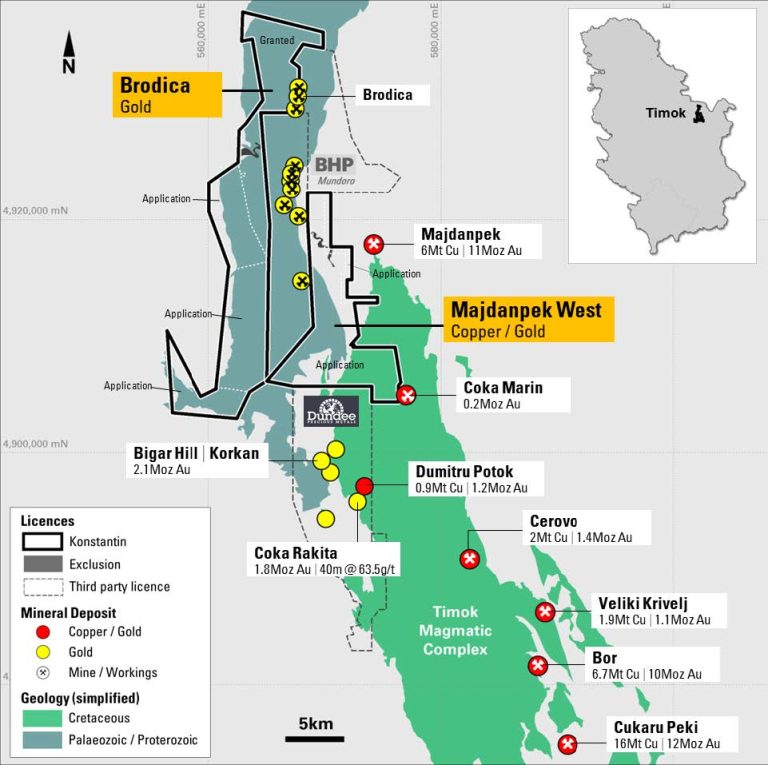
Timok comprises one granted exploration licence, the Brodica EL, and four exploration licence applications, including Coka Fantina, Brodica West, Majdanpek West and Majdanpek Pojas, covering an area of 218km2 (refer Figure 1).
Majdanpek West Target Area
Konstantin’s Majdanpek West target area (comprising the Majdanpek West and Majdanpek Pojas licence applications) encompass a part of Timok Magmatic Complex (TMC) and associated lithologies, which host multiple world-class mineral deposits in the region.
The Majdanpek porphyry, skarn and epithermal high-sulphidation Cu-Au deposit, and the Coka Marin epithermal high sulphidation Cu-Au deposits, are hosted within the TMC and are located immediately adjacent to the Timok Project licences.
The Majdanpek West area licences also include the projected northern strike extension of lithologies on the margin of the TMC that host Dundee Precious Metals’ Coka Rakita project that has a resource of 9.8Mt @ 5.67 g/t for 1.8Moz Au, and the Bigar Hill / Korkan deposits containing a combined resource of 49.8Mt @ 1.30 g/t for 2.1Moz Au.
Figure 1: Schematic geology of the greater Timok Magmatic Complex showing the location of significant deposits and Konstantin licence areas.
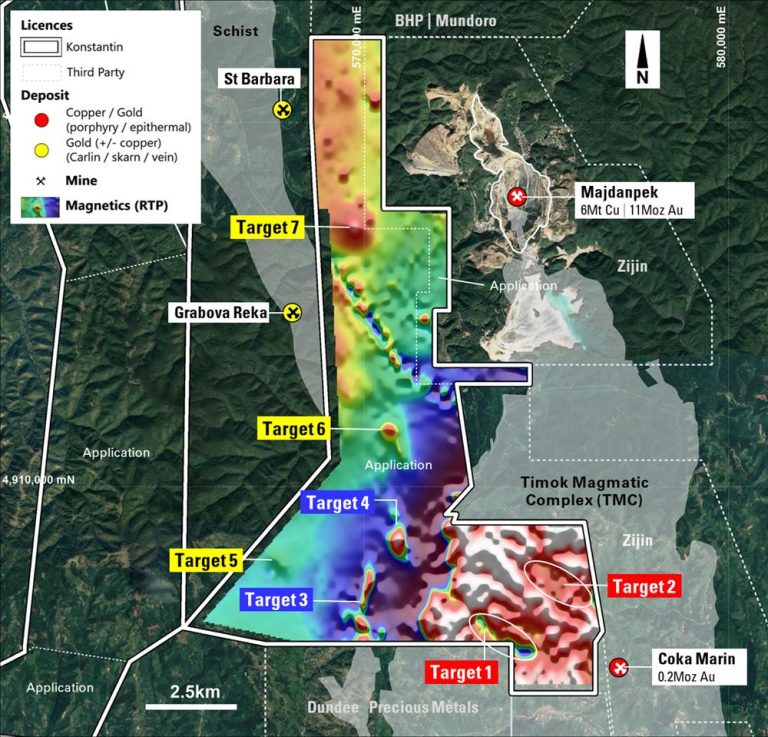
Konstantin has identified multiple copper/gold targets from airborne magnetic survey data, with prospective lithologies and multiple untested anomalies confirmed across the licence area (Figure 2).
A range of target deposit types have been identified including:
Porphyry/skarn and epithermal copper-gold deposits (TMC)
Carlin/skarn-type gold deposits (limestone-hosted deposits on flank of TMC)
Bonanza-grade vein-hosted gold-silver deposits (metasediments adjacent to TMC)
On-ground assessment, geophysical modelling and drill testing is now required.
Figure 2: Targets identified in aeromagnetic data for Majdanpek West area licences
Brodica Target Area
The Brodica district has a long history of mining stretching back 1,700 years with the main minerals extracted being gold & copper.
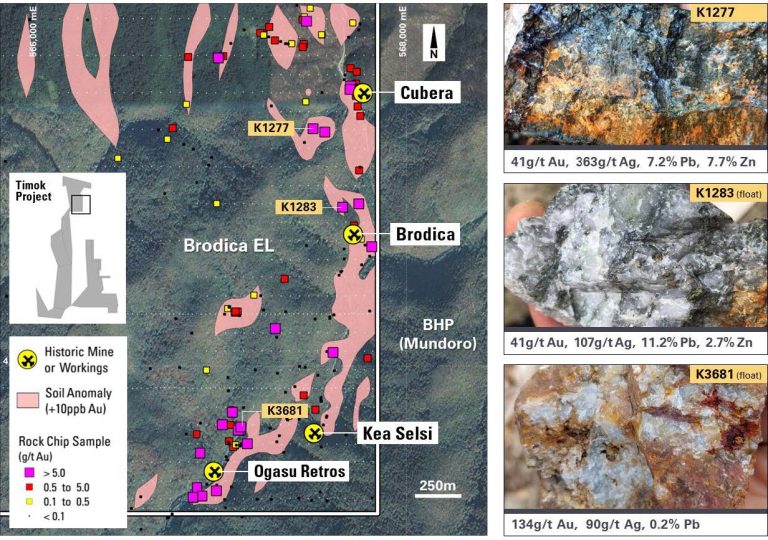
Konstantin has identified a 4km long gold in soil anomaly with rock chip and float samples grading up to 134g/t Au (Figure 3).
Historic mine plans record significant grades from underground face sampling:
Brodica: up to 114g/t Au & 179g/t Ag
Cubera: up to 41g/t Au & 2,385g/t Ag
Konstantin surface rock chip and grab samples include:
The immediate exploration program at Brodica will focus on further infill soil sampling to be followed by a trenching and additional rock chip sampling to identify and define drilling targets.
The infill soil sampling will close the sample spacing to a 50m x 50m grid around a currently defined, approximately 4km long zone of greatest gold-in-soil anomalism. Trenching and rock chip sampling will be used to test for shallow gold-silver mineralisation and to guide the definition of initial drill targets.
Drilling in the Brodica area is scheduled to commence in early 2026 and is planned to target both geochemical anomalies (defined by the above soil and trenching programs) and historic mine workings.
Figure 3: Soil and rock chip sample results from the Brodica target area